


Table of Contents
An employee feedback survey is a structured set of questions that measures how employees feel about their work, their managers, their growth, and their workplace. The strongest questions for 2026 pair rating-scale items on satisfaction, engagement, leadership trust, and change with two or three open-ended prompts, plus a short block on AI at work. Ask them consistently, keep them short, and be ready to act on the answers.
Most employees will tell you they're engaged. Far fewer will tell you they're staying. In Firstup's State of Employee Engagement research, 82% of corporate employees described themselves as engaged, yet 43% said they might look for a new job within the year. That gap is the problem with leaning on a single engagement score, and it's why the questions you ask matter more than the number they produce.
Collecting employee feedback is the most reliable way to learn how your organization is really doing on the employee experience. Getting real value from your survey efforts comes down to three things: asking the right questions, giving people an easy and safe way to answer, and showing that leadership will act on what comes back.
This guide covers the 33 questions worth asking, grouped by theme, plus how to choose between survey types, what to add for 2026, and how to run the whole process so people actually respond.
Key Insights
- 82% of corporate employees say they're engaged, yet 43% may look for a new job within a year, per Firstup's State of Employee Engagement research.
- Between 61% and 67% of employees say they have missed a critical workplace update.
- Gallup put global employee engagement at roughly 20% in 2025, a second straight year of decline led by managers.
- SHRM found about 41% of U.S. workers used AI for work in 2026, making AI a distinct survey topic.
- Survey fatigue is driven less by how often you ask than by asking without acting on the answers.
- Short, scale-based questions kept consistent across cycles produce the most usable trend data.
Why run an employee feedback survey?
An employee feedback survey is the most direct way to measure employee engagement and understand how employees feel about their work. Done well, it turns scattered opinions into employee sentiment you can track, and gives leaders actionable insights, not guesswork.
Engaged employees tend to stay longer and do better work, so a survey that catches early frustration lets you act before people leave. It gives quieter team members a safe way to raise issues, and comparing results over time shows whether your changes actually move job satisfaction and employee satisfaction.
What a good employee survey measures
A good employee survey measures more than a single score. The best employee survey questions span employee sentiment, workplace culture, and company culture; trust in senior management and the leadership team; and whether people understand the company's mission and the company's goals. When you survey employees across all of these, you can see how team engagement holds up across teams and team members, and whether employees feel they receive feedback that actually helps them improve.
A few habits make an employee survey worth running: keep your employee survey questions clear and neutral, survey employees on a predictable schedule, and share the survey results quickly. Run your employee survey the same way each cycle and it becomes a trend line, not a one-off. Treat employee engagement surveys and employee satisfaction surveys as complementary, since together these satisfaction surveys explain both how people feel and why.
Types of employee surveys
Most organizations run a few survey formats, each with its own purpose and rhythm.
Employee engagement surveys
Employee engagement surveys measure emotional commitment: whether people feel connected to the mission, their team, and their manager. These are usually run once or twice a year with a consistent core of questions so you can track team engagement over time.
Because an engagement survey is closely tied to retention, employee engagement surveys are one of the earliest warning systems you have for employee morale. The best employee engagement surveys keep the same survey questions year over year so the trend stays honest.
Employee satisfaction surveys
Where engagement surveys ask about commitment, employee satisfaction surveys ask about conditions. An employee satisfaction survey measures how satisfied employees are with the tangible parts of the job: pay, benefits, workload, tools, work-life balance, and the day-to-day work environment. Satisfaction surveys are practical and specific, and they pair well with engagement surveys, because a satisfied employee is not automatically an engaged one.
A short employee satisfaction survey run a few times a year keeps a read on morale between bigger studies. When employee satisfaction dips on one team, satisfaction surveys help you see whether it's pay, workload, or the work environment driving it, so you can respond before dissatisfied employees become departing ones.
Tracking job satisfaction this way turns a vague sense that something's off into a number you can act on. Because the survey results are so concrete, employee satisfaction surveys are often the easiest place to show quick wins: fix a broken tool or a scheduling headache, then watch the next round of satisfaction surveys move. Few satisfaction surveys are wasted when you act on them that fast.
Pulse surveys
Pulse surveys are short, frequent check-ins sent monthly or quarterly. Their value is speed: they catch problems between annual surveys, when a lot can change. The tradeoff is survey fatigue, so keep pulse surveys tight and spaced out. Used well, pulse surveys pinpoint the root cause of a spike in turnover before it spreads.
Exit and onboarding surveys
Two moments deserve their own surveys. Onboarding surveys check whether new hires have what they need. Exit surveys ask why employees leave, and often reveal patterns, like a lack of career development, weak training programs, or a difficult manager, that current employees won't say out loud. Both cut employee turnover.
Employee survey questions
Here's our list of 33 questions, grouped by theme so you can pull the ones that fit your goals. Mix rating-scale questions with a few open-ended prompts, and keep the wording consistent from one cycle to the next so you can track how answers move over time.
Employee satisfaction survey questions
These employee satisfaction survey questions focus on the conditions of the job, from workload and stress to benefits and work-life balance. They tell you how satisfied employees are with the everyday realities of working for you, which is the core of job satisfaction. They also touch on well-being, including mental health and stress, which increasingly shapes how satisfied employees feel.
- Do you have access to all the tools and resources you need to effectively do your job?
- In a typical week, how often do you feel stressed out?
- On a scale of 1-10, how fulfilled are you?
- How would you rate your work-life balance on a scale of 1-10?
- Do you feel supported if you need to make use of flexible working opportunities?
- How would you rate your level of happiness at work?
- Are you satisfied with the company's benefits, excluding your salary?
Employee engagement survey questions
These employee engagement survey questions get at pride, advocacy, and meaning, the emotional side of work that keeps engaged employees invested. They're the heart of most engagement survey designs.
- Would you recommend this company as a good place to work?
- Are you proud to work here? Why?
- Do you enjoy the work you are doing, and why?
- Do you find your work meaningful?
- If you were to accept a position at another company tomorrow, what would be your reason(s)?
Management and leadership questions
Managers and senior leadership shape the daily experience more than almost anything else. These questions check whether people trust the leadership team, receive constructive feedback, and feel heard.
- Do you feel comfortable asking your manager for help?
- How regularly is your manager recognizing your efforts?
- Does the feedback you receive from your manager help you grow in your position and career?
- Do you trust leadership to lead the organization to success?
- Are you involved in decisions that affect your job?
Career growth and development questions
People stay where they can grow. These questions probe career growth and professional development, and whether employees see real development opportunities and a future here. Answers here often point to concrete fixes, like better training programs or clearer paths for personal growth and career development.
- Do you feel that the company offers opportunities for development and promotion?
- Do you feel like you're progressing professionally, and if so, how? If not, how can we help?
Company culture and belonging questions
Culture is hard to measure head-on, so these questions come at it sideways, through belonging, workplace culture, and how connected people feel to their co-workers and team members. They also surface whether your company culture matches what leadership believes it to be.
- Do you feel connected to your coworkers?
- Do you feel comfortable contributing ideas in our workplace?
- Do you feel like the company has set clear goals and expectations for employees?
- Is our company dedicated to fostering diversity and inclusion in the workplace?
- Thinking back to your onboarding experience, how effective do you feel it was in getting you up to speed?
- In what ways do you feel/not feel like part of a team?
- Name two or three things you like best about working here
- Name two or three things you like least about working here
Communication and change questions
Change is where trust is won or lost. These questions check whether employees understand company decisions and know where to turn when something unexpected comes up. Clear answers here usually track with a healthy work environment.
- When the company makes changes, do you understand why they are done?
- When something unexpected comes up in your work, do you know where to seek help?
Open-ended questions
Open-ended questions provide the qualitative data that rating scales miss. A few well-placed prompts give employees room to explain the 'why' behind their survey responses.
- What could the company do to improve your work life?
- What challenges are you facing? Is there anything your manager or colleagues could do to help?
- What kind of events and team-building activities would you be most interested in?
- Is there something you think we should have asked you in this survey that we missed?
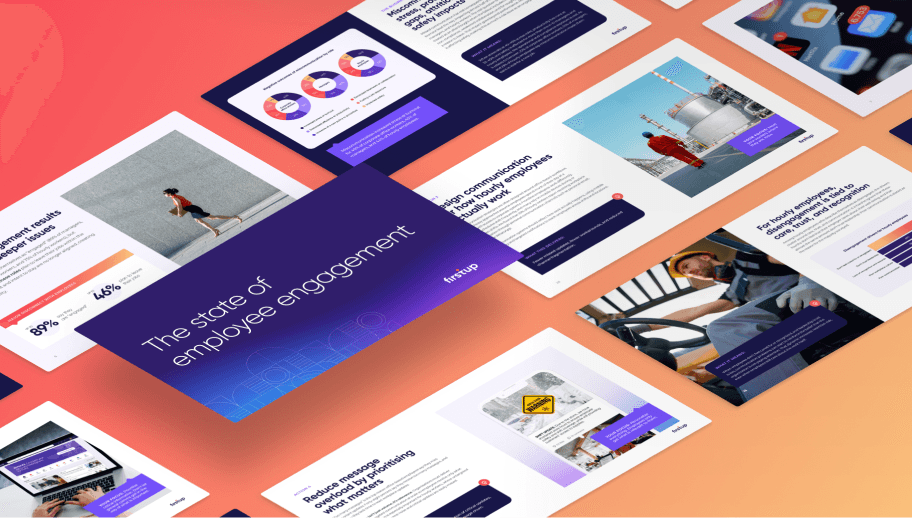
For more details, download our State of employee engagement report here.
The five types of survey questions
Most survey questions fall into five types: open-ended, closed-ended, rating scale, multiple choice, and demographic. Closed-ended and rating-scale questions yield quantitative data you can benchmark; open-ended questions provide qualitative data and often uncover issues you didn't think to ask about. A few employee demographics questions let you segment survey data by team, tenure, or location without identifying anyone.
One trick worth knowing is the funnel approach: funnel questions start broad and narrow to specifics, easing employees in before the detailed feedback. Keep the wording plain so every one of your survey questions measures what you think it measures.
What to ask in 2026: the engagement driver shift
For years, the go-to survey items asked whether people felt valued and whether they felt they belonged. Those still matter, but recent workforce data suggests they no longer predict engagement and retention the way they once did. Confidence in leadership and how well change is handled now carry more weight.
Gallup put global employee engagement at roughly 20% in 2025, a second straight year of decline that was driven largely by managers. When managers are the fault line, questions about manager support, recognition, and clear expectations tell you more than broad culture statements.
There's a second trap worth designing around: intent to stay and genuine motivation aren't the same thing. Someone can plan to stick around while quietly checking out, so a survey that folds everything into one engagement score can look stable until people leave. Ask about both, separately.
Questions worth adding for 2026:
- I believe this organization can successfully navigate the changes ahead.
- I have confidence in the decisions made by senior leadership.
- Recent changes have been communicated and implemented effectively.
- I feel motivated to do my best work here (asked separately from whether you plan to stay).
Asking about AI at work
AI showed up in daily work faster than most survey templates did, and leaders underestimate how much their teams already use it. The only fix is to ask.
SHRM found that about 41% of U.S. workers used AI for work in 2026, so a short, anonymous block on AI belongs in most engagement surveys now. Cover four things: how often people use it, what they use it for, whether it actually helps, and how they feel about it. Keep it anonymous, because employees underreport usage when they think they'll be judged.
The bigger reason to ask directly is that leaders are usually wrong about their own numbers. Executives tend to guess that only a sliver of their workforce uses AI daily, when the real share is several times higher. A survey settles that with data instead of assumptions, and it shows you where people lack access or training. It also helps to ask about managers specifically, because a manager who actively encourages AI is one of the strongest signals that a team will actually adopt it.
Sample AI questions:
- How often do you use AI tools in your day-to-day work?
- Which tasks do you use AI for most?
- Do AI tools make you more productive in your role?
- I have the training and support I need to use AI tools well.
- My manager encourages the team to use AI where it helps.
Benefits of running an employee feedback survey
Beyond the questions themselves, a well-run program earns its keep in a few concrete ways.
Give employees a voice
Employees who feel heard participate more honestly. A survey signals leadership wants input and gives every team member a channel beyond speaking up in a crowded room.
Turn opinions into measurable data
Surveys convert scattered opinions and raw survey results into survey data you can act on. Tracking the same questions over time turns anecdotes into survey insights and, eventually, into actionable insights leaders can prioritize.
Improve employee engagement and retention
Used consistently, feedback helps you improve employee engagement and employee retention at once. When you measure employee engagement, act, and show results, employees are less likely to leave, which lowers employee turnover and protects employee productivity.
Hold leadership accountable
Finally, surveys hold the leadership team accountable to the company's goals. Published results and named owners make it clear that feedback leads somewhere.
Making employee surveys more useful
We told you we would return to this, so here we are! But we won't entirely rehash our earlier post on building a meaningful employee listening program, so we'll keep this part short. Here are a few ways to jumpstart your survey program to make it the most useful for employees and employers.
Build better surveys
A quick primer on formats, since the words get used interchangeably. A pulse survey is a short, frequent check-in of a few questions. An annual engagement survey is a longer, once-a-year instrument that covers the full employee experience. An eNPS survey is a single question that asks how likely someone is to recommend your company as a place to work. Most mature programs use all three.
- Make them clear
- Keep them simple and short
- Offer a variety of formats
- Use templates (the Firstup intelligent communication platform can help with this!)
- Avoid coercive/leading questions that make it clear that one of the answers is the 'right' one. Example: 'How awesome are we?'
- Avoid Yes/No responses when possible
- Target your audience(s)
- Offer opportunities for anonymous answers, and mean it, no looking!
- Have fun!
A few design habits separate surveys people finish from surveys they abandon:
- Keep it short. Every extra question costs you completions, so cap pulse checks at around five questions.
- Use rating scales, not yes/no. A five-point scale captures the people in the middle that a yes/no question erases.
- Explain how anonymity actually works. Say how responses are grouped and who sees them, rather than just promising it's anonymous.
- Mix question types. Pair rating questions for trend tracking with two or three open-ended prompts for the 'why.'
Empower those close to employees
- Give those closest to colleagues the tools they need to build on existing levels of trust.
- Engage with employee resource groups to target tough questions and discussion guides.
- Run location-specific or role-specific focus groups.
Commit to action before asking
- Before you ask any questions, be ready to respond to what you get back.
- Communicate the course of action for your findings.
- Understand that when decisions are made without input from employees, they tend to start holding back their ideas.
- Show employees that you trust them and value transparency.
This is where most survey programs quietly lose people. When employees share feedback and then see nothing change, they stop answering honestly, so the single biggest thing you can do to keep response rates healthy is to act visibly on what you hear.
How to build and run an employee survey
If you're starting from scratch, a simple six-step process keeps an employee survey focused and useful.
Step 1: Define your objectives
Start with one clear goal tied to the company's objectives. A survey that measures everything measures nothing, so decide what decision the results will inform first.
Step 2: Identify your KPIs
Decide how you'll judge results. Whether it's an engagement score, an eNPS number, or a satisfaction metric, naming KPIs up front makes the survey data comparable cycle to cycle.
Step 3: Plan the survey timeline
Map the calendar. Coordinate with any other teams running their own surveys so you don't overload people, and decide the cadence, annual surveys, quarterly pulses, or both, in advance.
Step 4: Choose your question types
Pick a balanced mix of survey questions: rating scales for trends, a few open-ended prompts for context, and only the demographic items you'll actually use.
Step 5: Analyze and act on the results
This is where value is won or lost. Read the survey results, find the two or three themes that matter, and turn them into a short action plan. Good analysis is how you uncover actionable insights, not a wall of charts.
Step 6: Establish a follow-up procedure
Close the loop. Share what changed, then use short follow-up surveys to check whether it worked. Responding in a timely manner, and giving employees timely feedback, is what earns honest answers next time.
Firstup allows us to make it happen
The best way to reduce turnover is to increase engagement. One of the best ways to energize the team about the work they're doing is to highlight it for the rest of the organization to see.
For more details, download our State of employee engagement report here.
Ask useful questions, get useful answers
If your company wants to better understand how your employees feel about their work, you need to ask them questions that will give you the 'inside track' of how they are doing. In addition, you need to be ready to act on that feedback in a meaningful way. Because business units with the highest employee engagement are 23% more profitable than those with the lowest, you must listen and act on input from your team!
For companies looking to better understand and act on the needs of their employees, the Firstup Analyze dashboard, built into our intelligent communication platform, helps employers to monitor and drive action by showing how your people respond to critical initiatives. Business leaders can generate reports on every aspect of an employee engagement and communications program, from executive summaries to in-depth detail.
The questions are only half of it. The best programs close the loop, showing employees what their input changed.
To learn more about Firstup, click the button below for a demo!
Deliver a hyper-personalized employee experience at scale
Frequently asked questions
Table of Contents
Related posts
Subscribe via Email
Subscribe to our blog to get insights sent directly to your inbox.
Related posts




Sign up to receive the latest news and resources from Firstup
Firstup delivers personalized communication and data insights to improve the employee experience at every moment that matters